




In 2007 Chevrolet put a trio of city car concepts on display at the New York Motor Show and invited the public to pick the design they liked best. Over a million votes later the 'Beat' concept was chosen. Now the production version is here and Chevrolet have stayed faithful to the bold lines of the original design but changed its name to 'Spark'.
The Spark takes the place of the Matiz in Chevrolet's range. But the company is aiming the new car squarely at a much younger market than those who bought that model.
Accordingly, the car already made a cameo in summer blockbuster Transformers 2 as the robot 'Skids'. Happily, driving the car is a more satisfying experience than Michael Bay's smash-a-thon.
And it's a better use of your money too. The entry-level Spark comes in just short of £7,000 (assuming VAT goes back up to 17.5% in January).
For basic mod cons like electric windows, central locking and air-conditioning you'll need the Spark + which starts from £8,145.
That makes it a very competitive proposition against the likes of the Kia Picanto and Hyundai i10. But can the Spark show us anything to rival the likes of the Toyota Aygo, Citroen C1 and Fiat Panda?
The Spark's chunky design looks great on the road. It shrugs off the 'I'm-just-a-rebadged-Daewoo' look of the Matiz and the bold gold badge on the front screams 'I'm a Chevrolet!'
Its large headlight clusters have a touch of the Fiesta about them but that large, split grille sets it apart from anything else on the road in its class. The rear light clusters and the crease in its flanks above the wheel arches add to the modern look.
Only in profile does the car lose some of its lustre, with the tall sides making even the optional 15-inch alloy wheels look too small.
Inside the designers have made an effort to carry on the funky styling but the constraints of their budget have had a noticeable effect. There are a lot of plain switches and a dull gear lever with a distinctly rubbery feel. But all the controls are clearly laid out and easy to use.
In an attempt to give the driver something more interesting to look at the major instruments are housed in a large plastic assembly which nestles just behind the steering wheel.
This has some advantages over a traditional arrangement - it's much easier to see the speedometer and other dials. But some will find the LCD screen and plastic surround a bit tacky - have a look at our close-up pictures to judge for yourself.
With its diminutive size and rapid steering the Spark is most at home in the city. Visibility around the car is very good and the ride, though slightly firm, is generally comfortable.
It has quite a high driving position and limited scope for adjustment. The tall roof means rear passenger headroom is better than you'd expect for such a small car. But with limited legroom full-grown adults will find long distances uncomfortable.
Take it out onto the motorway and even the larger of the two engines - the 1.2-litre petrol - labours at higher speeds and you need a decent stretch of road to overtake safely.
The steering, which is light and nimble at low speeds, also feels a little uncertain when you're going quickly.
There's no question the Spark is a big improvement on Chevrolet's previous city car offering. Unfortunately it won't arrive here before spring, which will likely be just after the scrappage scheme comes to an end.
But even without that leg-up Chevrolet have a car which potential Picanto and i10 buyers should take a serious look at. Those on the market for a Panda or a C1 may also be tempted by its neat looks and low price tag.
 Perfect Fit Transmission Assembly
A little while back - forty years ago - Peter Brock's Brock Racing Enterprises won the SCCA National Championship at Road Atlanta with a 240Z driven by John Morton.
 Now, on the 40th anniversary of the original win, BRE is celebrating the first official ass-kicking Japanese racer on American soil with a special new 370Z.
Based on the Nismo 370Z Coupe, it will be "built to current SCCA T2 racecar regulations and will see track duty later this year." It will also feature a distinct red, white, and blue BRE paint scheme.
The BRE 370Z is set to debut April 29 at the Classic Motorsports Mitty at Road Atlanta. If you can't get down there, the car will also be making appearances a Z Club events nationwide.
By Phil Alex


Looking back now, the only question is why the 2010 Mercedes-Benz E350 CGI didn't arrive sooner.
It is hard to figure why the current second-generation Mercedes-Benz CLK managed to sell quite as well as it has. Sure, it has a shiny three-pointed star sitting up front on the grille, but it is based on the humble underpinnings of the C-Class and draws its styling influences for the most part from the previous-generation E-Class, itself no classic in the looks department.
Worldwide sales topped 250,000 in seven years, an outstanding performance. But now that the Audi A5 and BMW 3 Series have begun to encroach on the CLK's turf, Mercedes-Benz has finally responded.
And the 2010 Mercedes-Benz E350 CGI isn't at all like the CLK.
The New Deal
Unwilling to take the CLK into a third generation, Mercedes has replaced its hugely successful two-door with this car, the 2010 Mercedes-Benz E-Class Coupe. And because it's based upon the recently introduced launched E-Class sedan, it moves this model into a rather more exclusive part of the coupe market where it will line up against a production version of the Audi A7 concept shown earlier this year as well as next year's all-new BMW 6 Series.
It is the 2010 Mercedes-Benz E350 CGI's distinctive styling that clearly represents the most obvious change, as the car adopts cues from the E-Class sedan. But where its four-door stablemate has adopted a stately look in its latest incarnation, the E-Class coupe instantly looks lithe thanks to its edgy, pillarless roof. (There's also a convertible version of this car in the works, but don't expect to see it until this time next year. Like the outgoing CLK cabriolet, the new car features a traditional fabric top.)
Given its upmarket positioning, the E-Class coupe is larger than the old CLK in almost every dimension. Overall length goes up 1.9 inches to 185 inches, while overall width has increased 1.9 inches to 70.3 inches. Despite going up in size, improved production techniques have seen a 27 percent increase in overall structural rigidity of the body. The wheelbase has increased by 1.8 inches to 106.9 inches, while the front track has increased 1.7 inches to 60.6 inches and the rear track has increased a considerable 2.7 inches to 60.8 inches.
More Living Space
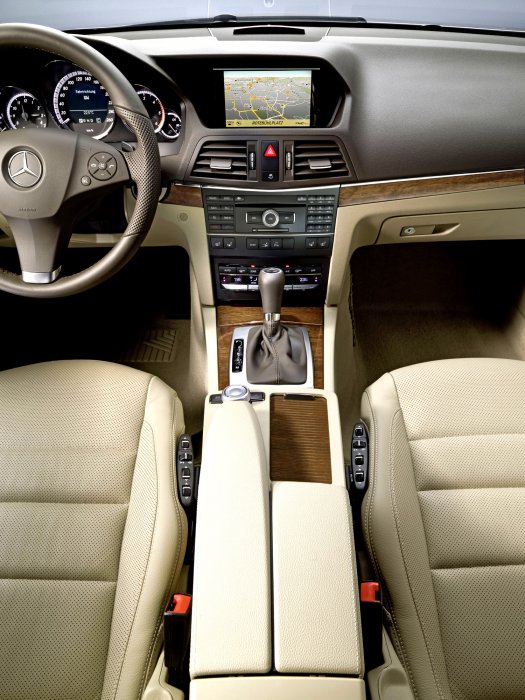
The stretched dimensions are put to good use inside the cabin, where accommodations have been enlarged in every dimension. You wouldn't call it palatial, but by the standards of a two-door, there's adequate space for four full-size adults along with a decent amount of luggage space (the trunk's capacity of 15.9 cubic feet puts many dedicated sedans to shame).
The design of the interior draws heavily on that found in the new E-Class sedan, which itself is redolent of that seen in a number of Mercedes-Benz models of late. The excellent seats have been developed specially for the E-Class coupe, and they can be adjusted to a quite low driving position, fittingly sporting for a coupe. Meanwhile, the stretch in wheelbase and width dimensions has also created added space for front-seat occupants. With no B-pillars to block your view, there are no blind spots over your shoulder, although the headrests of the rear seats severely restrict the view out of the rear window.
In the current fashion, there are just two seats in the back, and they're separated by a prominent center console. While benefiting from the added legroom in this new package, rear-seat occupants will find headroom is restricted by the curvature of the roof, which plunges quite dramatically.
Motoring
The rear-wheel-drive E-Class coupe will launch in Europe with seven different engine options — three of them gasoline and two diesel. North American buyers will get to choose between just two of these engines, a 292-horsepower 3.5-liter V6 for the E350 CGI and a 388-hp 5.5-liter V8 for the E550 CGI. Each comes with Mercedes-Benz's excellent seven-speed automatic transmission. A number of mpg-boosting innovations have been introduced under the German carmaker's BlueEfficiency banner, including brake energy regeneration, an on-demand water pump and low-rolling-resistance tires.
For our first drive we choose the E350 CGI, which will form the majority of sales here in North America. Twist the key and the first impression is of exceptional refinement. At idle, the engine is so quiet that it's barely perceptible from behind the wheel.
Once under way, this direct-injection V6 offers crisp response and impressive levels of performance. Left in Sport mode, the automatic gearbox works well, as upshifts are almost seamless even under full throttle and downshifts come swiftly. The V6 doesn't produce its maximum torque of 269 pound-feet until 3,000 rpm is wound on the dial, so it needs to be worked a bit before it can be coaxed into delivering its full potential. But with such a hushed nature and an inherent willingness to rev to the 6,800-rpm redline, this is no real hardship.
Acceleration reveals just how effective the new high-compression engine really is, as the sprint to 100 km/h (62 mph) from a standstill takes just 6.5 seconds. The E350 CGI achieves a top speed of 155 mph, making it a good deal faster than the old CLK320 and more than a match for its keenest rivals, the Audi A5 3.2 FSI and BMW 330i coupe.
Serenity
The E350 CGI is further distinguished by its deeply impressive on-road character. Your first impression is of real serenity, but as we went faster, this car's optional Advanced Agility Control package came into play. It combines variable-rate steering and electronically controlled shock absorbers that can be set in three distinct modes (Normal, Comfort and Sport).
The most satisfying feature is its ability to cruise down the highway with quiet confidence, tremendously well insulated from road and wind noise. Part of the performance comes from extensive wind-tunnel testing, because the E-Class coupe's 0.24 Cd is the sleekest of any production car, Mercedes tells us. You're nicely insulated from the road, but not anaesthetized, a telling distinction that Mercedes seems to understand very well.
You could add composure to this list, too. Body movement is well checked as long as you don't do anything too extreme over challenging sections of bitumen. While the steering effort initially feels a touch too light for any real engagement with the act of driving, it becomes more accurate and informative as your speed increases.
There's plenty of cornering grip and the handling is safe and neutral, with a bias toward understeer near the limits of adhesion. With serious provocation, you can coax the E350 CGI to drift into oversteer, though the stability control quickly responds to any wayward action even when disengaged. Dynamically, this is an impressive package, a real improvement on the old CLK, even if the overall impression is not exactly sporting in nature. The most impressive thing is the way this new coupe eats up the miles with such nonchalant ease.
New Priorities
The 2010 Mercedes-Benz E350 CGI represents a shift in priorities for Mercedes-Benz. Conventional new model logic would have seen the Stuttgart automaker freshening up the CLK for another generation, an affordable, incremental improvement to fend off the competition. Yet what has been delivered is nothing less than an all-new model that is positioned a whole class higher than the car it replaces.
Objectively, the 2010 Mercedes-Benz E-Class Coupe is a better car in every aspect. However, success for cars like this is rarely if ever based upon simple objective advantage. Instead a coupe's chances in the marketplace are all about pure desirability, and it is here where this car makes its case.


Running preproduction prototypes of your new car at the Nürburgring has become as de rigeur for auto manufacturers as putting an engine under the hood and a patch of rubber at each corner. This practice is certainly making it easy for our spy photographers, who can pretty much set up camp and wait for the cars to come to them.
Most recently, our shooters captured a pair of Mercedes-Benz prototypes working out at the famous Eifel Mountain racetrack, the SL65 AMG Black Series and this 2010 E-class.
Though the matte-black shrink wrap hides the details of the head and taillights, it does little to mask the crisp new body lines. Certainly not the katana-hewn angles of a Cadillac design, the C-class–inspired cuts on the 2010 E-class’s sheetmetal are nonetheless razor sharp compared to the stately and curvaceous shaping of the model it replaces.
Taut creases in the side metal may be a relatively dramatic change, but the overall character of Mercedes’s mid-size sedan will remain unchanged. Expansive glass still fills an upright greenhouse, and even the car’s size will change very little. The platform underpinning the car seen here is an evolution of the previous-generation car’s, so expect dimensions to ebb and grow by mere fractions in any direction.
Our sources tell us there will also be little change in the engine room, where the V-6 diesel in the E320 BlueTec and the V-8 in the E550 will receive only minor updates. E350 models will see an additional 32 horsepower arrive courtesy of the direct-injection V-6 from the 2009 SLK350. We can only hope the bawdy E63 AMG sees even more than its current 507 horsepower, but if it doesn’t, we’ll still love it.
Expect the rest of the wrapping to stay on the E-class until the Geneva auto show in March of 2009. The car will start to appear in American showrooms the following fall, with the AMG to drop sometime in 2010.


